Sustainability reporting software for the review side
The features ESG reporting tools are missing
Most sustainability software helps you create reports. ReportingGPT helps you review them – with audit-grade structure, three comment dimensions, and export formats your auditor actually accepts.

From upload to audit-ready export. Four steps.
1
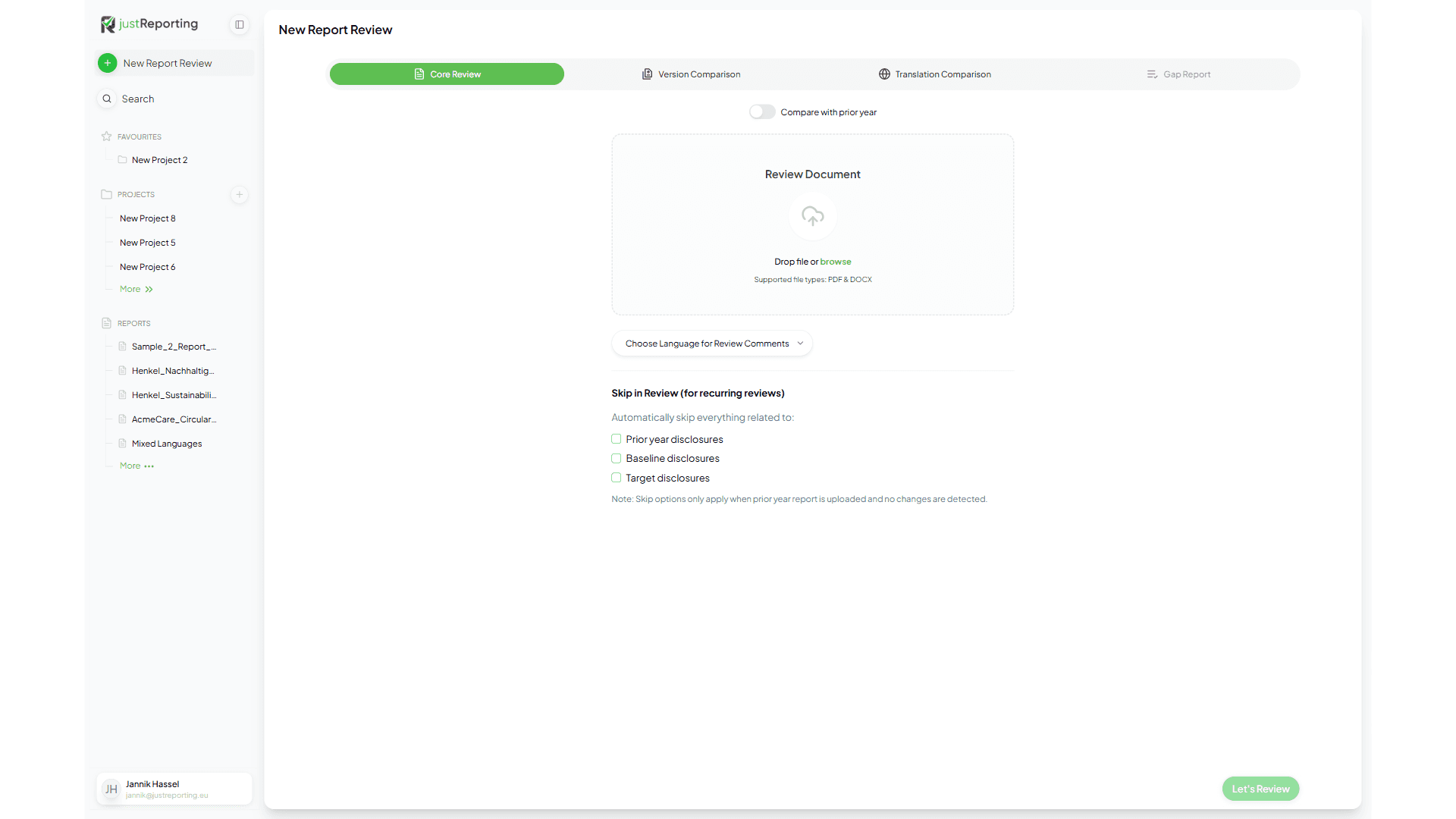
Upload
PDF or DOCX – your sustainability report goes in.
2
Choose mode
Core Review, Version Comparison, Translation, or Gap Report.
3
Review
Structured audit-grade comments appear directly in the document.
4
Export
Resolve findings, export your audit-ready review pack as PDF or Word.
Four review modes
Built around how auditors actually work
Not generic AI features – purpose-built review workflows for every stage of the CSRD assurance process.
Core Review
The review your auditor would do – in hours, not days
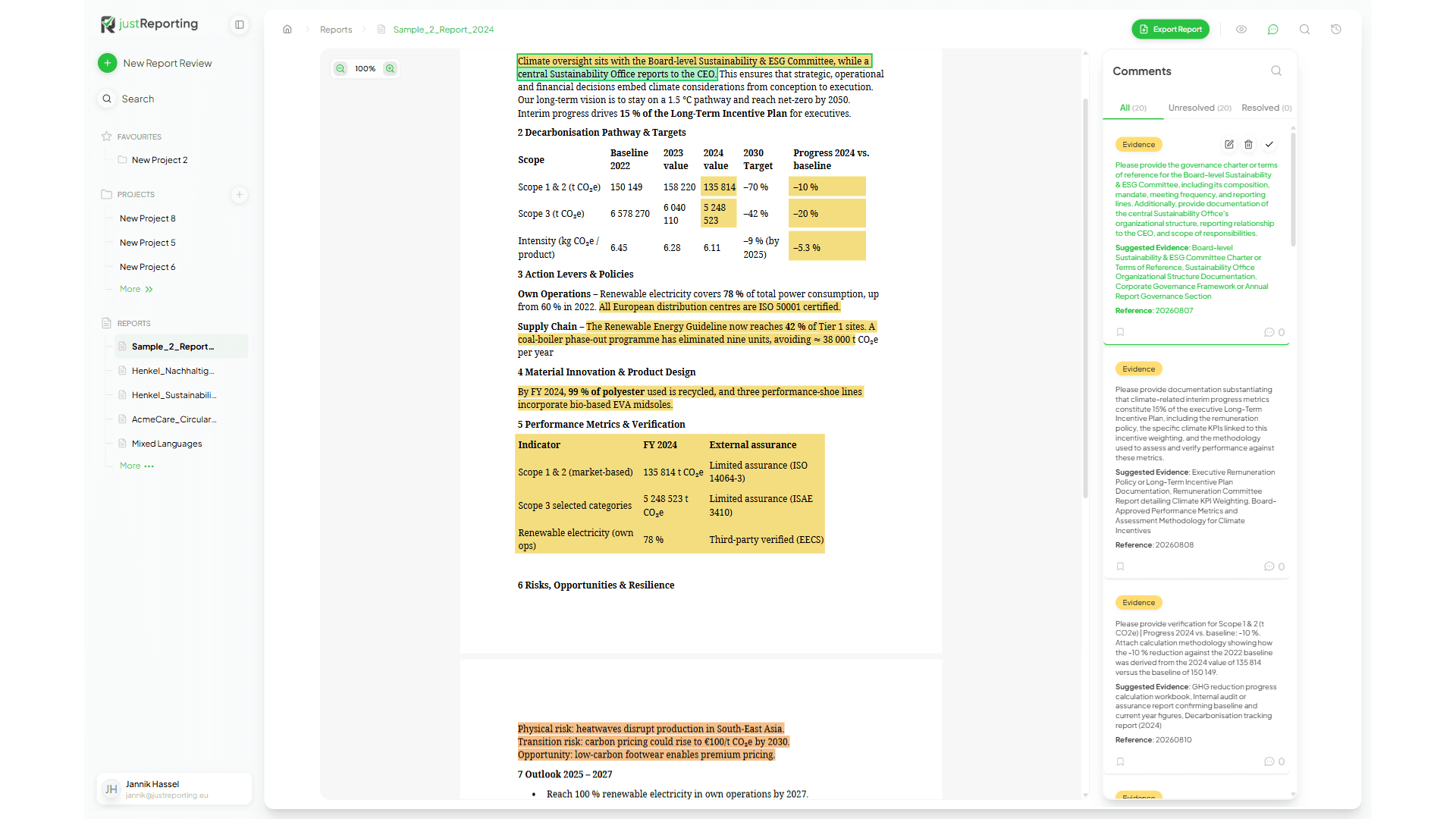
Upload your sustainability report as PDF or DOCX and receive structured comments that mirror real audit methodology. Every comment falls into one of three audit dimensions – Clarification, Evidence, or Proofreading – so you and your team know exactly what to do next.
“Manual first-pass review takes 2–3 days per report. With growing CSRD mandates, that doesn't scale.”
- Structured comments on every relevant passage
- Optional prior-year report comparison for continuity checks
- Status tracking: Open → In Progress → Resolved
- Covers all material ESRS disclosure requirements
Version Comparison
Stop re-reading the entire report after every revision
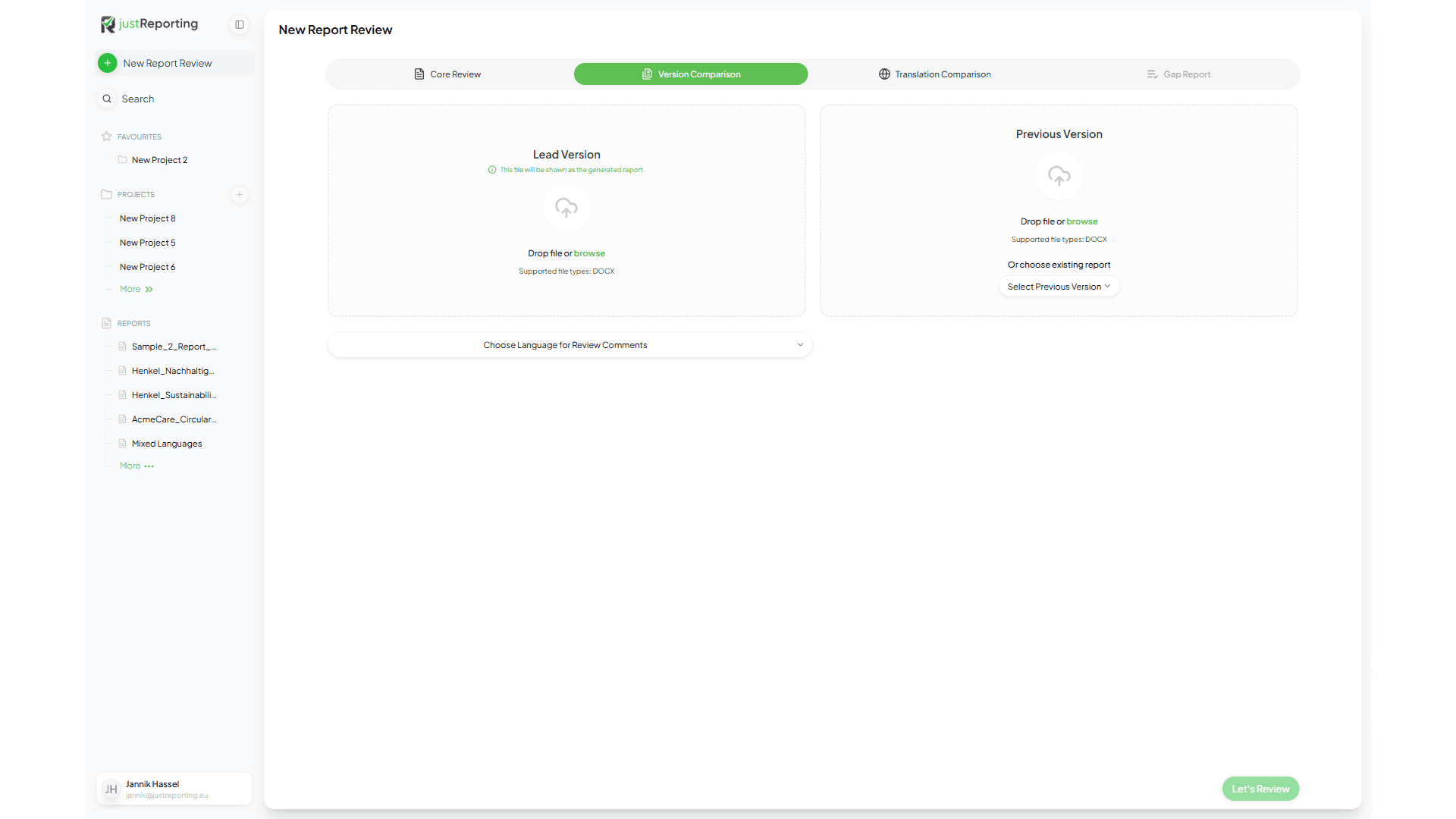
Compare two report versions and focus your review exclusively on new, modified, or removed passages. ReportingGPT detects changes across sections and flags regressions – content that was previously approved but has been altered or removed.
“When version 4 arrives, nobody wants to re-read 200 pages to find what changed. And nobody should have to.”
- Automated change detection across all sections
- Review only what actually changed – save hours
- Regression alerts for previously approved statements
- Works with uploaded files or previously reviewed reports
Translation Comparison
One figure. One scope. Every language.
For companies publishing sustainability reports in multiple languages: verify that figures, scope definitions, and material statements are consistent across all language versions. Catch divergences before they become compliance findings.
“A Scope 3 boundary defined differently in the German and English version is a finding waiting to happen.”
- Cross-language consistency check (EN/DE and other pairs)
- Flags numerical and definitional divergences
- Detects scope and boundary inconsistencies
- Reduces risk for international stakeholders and auditors
Gap Report
Your assurance readiness dashboard
Aggregates all open findings by category, severity, and status – giving you a clear picture of how assurance-ready your report is. Formatted for management review, project steering, and auditor handover. Export as PDF or Word with one click.
“Stakeholders don't read 200 comments. They need a structured overview that tells them: are we assurance-ready, or not?”
- Assurance readiness overview at a glance
- Findings grouped by Clarification / Evidence / Proofreading
- Open vs. Resolved status dashboard
- One-click export as PDF and Word for auditor handover
Audit methodology
Three comment types. One audit logic.
Not AI categories – audit dimensions. Each comment type mirrors how certified auditors think about a sustainability report: transparency, evidence, and formal quality.
Is this statement verifiable?
Pinpoints where scope, methodology, baselines, or reporting boundaries need to be made explicit. A Clarification comment means: an auditor would ask about this – and the answer isn't in the report yet.
Example comments
"Baseline year for the 40 % reduction target is not defined – auditor will require this for trend verification."
"Organisational boundary for Scope 3 emissions is not described. ESRS E1-6 requires explicit methodology."
"EU Taxonomy assessment methodology is referenced but not described – limited assurance requires disclosure."
Where is the proof?
Requests supporting documentation with concrete suggestions – so evidence gaps are identified and closed before assurance starts. Each Evidence comment includes a 'Suggested Evidence' recommendation.
Example comments
"Suggested evidence: sustainability committee charter or board resolution establishing ESG governance."
"No reference to a GHG verification certificate for Scope 1 figures – required under ESRS E1."
"NGO partnership mentioned – supporting agreement or MoU should be referenced for audit trail."
Is this publication-ready?
Identifies draft markers, internal placeholders, inconsistent terminology, and structural issues. A report with Proofreading findings isn't wrong – it's not finished.
Example comments
"[PLACEHOLDER] text detected in section 3.2 – section not yet finalized for publication."
"'Material topics' and 'wesentliche Themen' used interchangeably – standardise terminology across the report."
"Section header references 'Chapter 4' but document uses only numbered sections – fix cross-reference."
ESG reporting software vs. ESG assurance software
Most tools on the market help you collect data and produce a report. ReportingGPT starts where they stop.
Reporting tools
Workiva, SAP, Prophix
Review tool
ReportingGPT
Data collection & dashboards
Report generation & templates
Structured audit-grade comments
Version comparison with regression alerts
Translation consistency check
Gap Report for auditor handover
Audit trail for working papers
Built by a licensed audit firm
ReportingGPT is not a replacement for reporting platforms – it's the quality gate between report creation and audit sign-off.
When to use what
A typical ESRS reporting cycle runs from October through February. Here is when each feature adds the most value.
Core Review
Structured audit comments on your report
Version Comparison
Track changes between draft cycles
Language Comparison
Verify translation matches original
Gap Report
Assurance readiness for sign-off
Core Review
Oct – FebStructured audit comments on your report
Formats: .docx, .pdf
Version Comparison
Nov – JanTrack changes between draft cycles
Formats: .docx only
Language Comparison
Jan – FebVerify translation matches original
Formats: .docx, .pdf
Gap Report
Feb +Assurance readiness for sign-off
Formats: PDF, Word
Typical timeline – all features are available year-round.
Frequently asked questions
Audit-focused sustainability reporting software needs structured commenting (not generic AI output), version comparison for iterative reviews, evidence tracking, and export formats compatible with working papers. Most ESG software focuses on data collection – ReportingGPT focuses on the review and assurance phase.
Auditors document their review findings in structured categories: Clarification (scope and methodology questions), Evidence (documentation requests), and formal quality issues. ReportingGPT automates this structure and exports it in PDF/Word formats suitable for audit working papers.
An ESRS gap analysis identifies disclosure requirements that are not adequately addressed in the sustainability report. ReportingGPT's Gap Report aggregates all open findings by category and status, providing a structured overview for management sign-off and auditor handover.
Yes. ReportingGPT is trained on ESRS disclosure requirements and reviews your report against them. It identifies missing disclosures, insufficient methodology descriptions, and undocumented evidence – structured as actionable comments, not generic AI suggestions.
Version comparison automatically detects changes between two report versions – additions, modifications, and deletions across all sections. ReportingGPT also flags regressions: previously approved statements that have been altered or removed in a newer version.
ReportingGPT provides a structured assurance readiness assessment by reviewing your report against ESRS requirements across three dimensions: Clarification (are statements verifiable?), Evidence (is supporting documentation referenced?), and Proofreading (is the report publication-ready?). The Gap Report gives you a clear assurance readiness overview – so you know exactly where you stand before the auditor arrives.
ESG reporting software helps create sustainability reports (data collection, dashboards, templates). ESG assurance software helps review them (structured comments, gap analysis, working papers). ReportingGPT is built for the review and assurance side – the part that happens after the report is written.
See it on your own report.
Upload your sustainability report as PDF or DOCX and receive audit-grade comments in hours – not days.
EU data residency · No training on your data · Built by a licensed audit firm